Everything you need to know about tempering chocolate, from the simple science behind the process to my go-to, easiest methods.
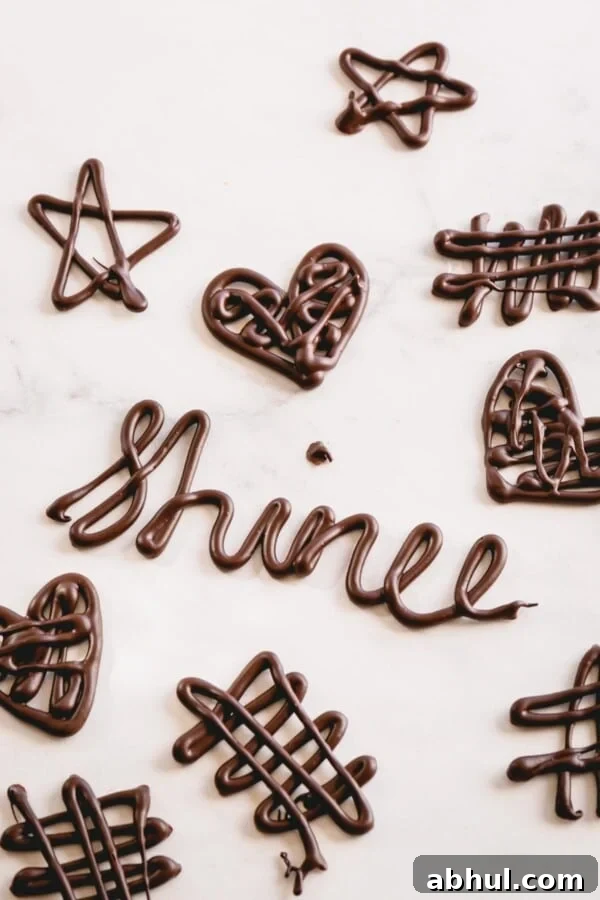
If you’re coating truffles, dipping strawberries, or making delicate chocolate decorations for cakes and cupcakes, tempering is an essential skill. Properly tempered chocolate gives professional results and makes your finished pieces more stable and attractive.
5 main reasons to temper chocolate
- Tempered chocolate has a glossy, attractive finish.
- It sets dense and solid rather than soft and fragile.
- It breaks with a clean snap instead of tearing.
- Tempered chocolate resists melting from touch and won’t show fingerprints easily.
- It sets quickly—typically within 3–4 minutes for thin coatings.
If you skip tempering and simply melt chocolate, the result is often soft, slow-setting chocolate that easily shows fingerprints, melts at touch, and breaks without a crisp snap. Melted-only chocolate tends to be dull and can develop white streaks or bloom.
Science behind the process
Understanding the basic science makes tempering logical and straightforward. Here’s a plain-language explanation of what happens and why we control temperature so carefully.
- When chocolate is heated to about 113–122°F (45–50°C), the cocoa butter melts and any existing fat crystals dissolve, turning the chocolate into a smooth liquid.
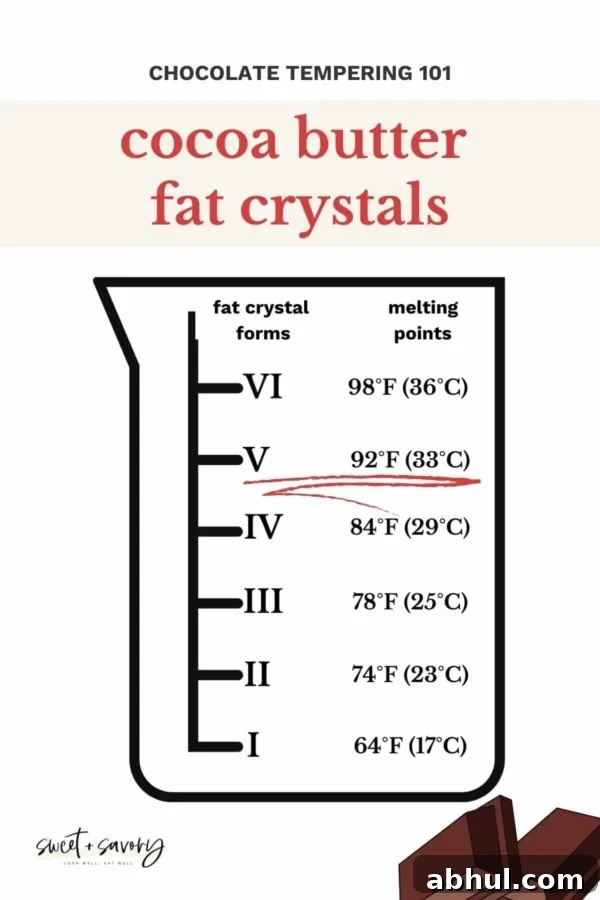
- As melted chocolate cools, cocoa butter recrystallizes into one of six possible crystal structures (forms I–VI). Each form has a different melting point and stability.
- Form V (beta crystals) is the desirable structure: it creates a glossy finish, a good snap, and a higher melting point. That’s what we aim to form when tempering.
- If cooling happens uncontrolled, cocoa butter can form unstable crystal types that lead to soft texture, dull appearance, streaks, and low melting point.
- Beta crystals form naturally around 90°F (32°C), but forming them quickly is helped by cooling down to around 82°F (27°C) to encourage nucleation. Cooling too far also promotes some Form IV crystals, so we then gently reheat to 90°F (32°C) to melt Form IV while retaining Form V. The sequence of heating, cooling, and reheating is what yields the stable beta crystal structure.
How to temper chocolate
Now that we know the goal—produce stable beta crystals—let’s look at reliable, easy methods to achieve it. Two of the simplest approaches are seeding and a microwave technique suitable for small batches.
Method 1 – Seeding (recommended)
Seeding is a dependable method and works well for larger batches. A good kitchen thermometer helps a lot. Work in a cool room (around 65–70°F is ideal); temperatures above 75°F make tempering much harder.
Tip
Avoid any contact between water or steam and the chocolate when using a bain-marie. Even a small amount of moisture will seize the chocolate and make it grainy and unusable.
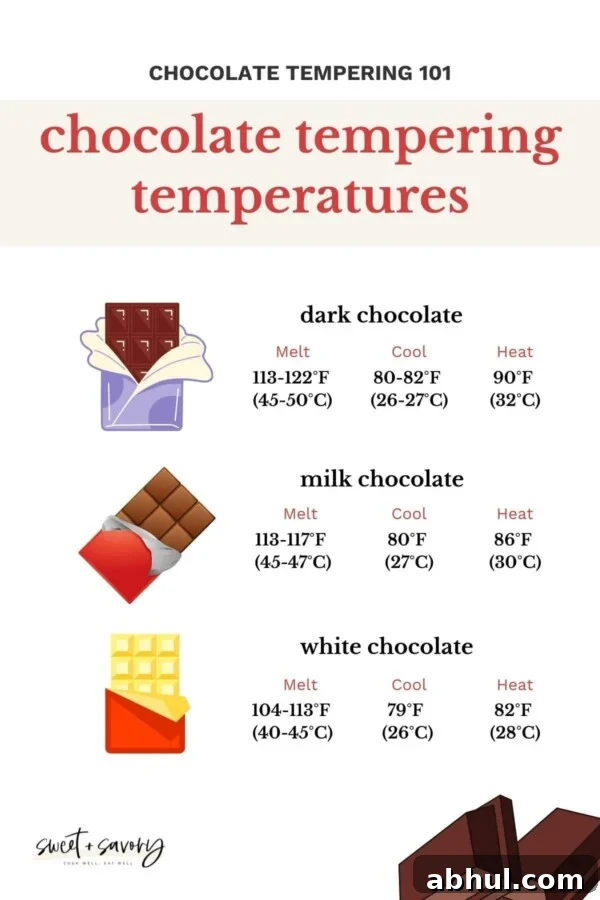
*Temperatures below apply to dark chocolate. Milk and white chocolate require lower temperatures—refer to the specific temperature chart or manufacturer guidance for those varieties.
- Melt about 60% of your dark chocolate in a heatproof bowl over a bain-marie until the chocolate reaches 113–122°F (45–50°C). Keep the bowl above but not touching the water and keep the water barely simmering. (Example: ~150 g chocolate takes roughly 3 minutes, but time varies with quantity.)
- Remove the bowl from the heat and add roughly half of the remaining chocolate (finely chopped) as seeds. Stir continuously; continue adding the rest of the chopped chocolate while stirring until the temperature drops to about 80–82°F (26–27°C).
- Return the bowl briefly to the bain-marie and gently raise the chocolate temperature to about 90°F (32°C), stirring constantly. Depending on batch size this may only take a few seconds. That final heat melts unstable crystals while preserving the beta crystals.
Tip
Stir quickly and continuously during cooling and reheating. Vigorous stirring encourages many tiny seed crystals to form, which helps create a uniform crystal structure and glossy finish.
Method 2 – Microwave (simple, small batches)
The microwave method is quick and works well for small amounts. Once you learn how your microwave performs with chocolate, you can often temper without a thermometer. This method requires some trial and error to dial in timing and power for your appliance.
Commercial chocolate bars are already tempered. If you melt chocolate in the microwave but never exceed about 90°F (32°C), you won’t destroy the temper.
- Chop or grate the chocolate finely—smaller pieces melt more evenly. Use a plastic or silicone bowl; glass can retain heat and may overheat the chocolate.
- Microwave at full power for 1 minute (this example uses a 1000 W microwave). Remove and stir thoroughly.
- Then microwave in 10-second bursts, stirring between each burst, until most pieces are melted and the mixture is smooth. The residual heat from stirring will finish melting small pieces without overheating.
- Adjust the total time and power level based on your microwave and the amount of chocolate. Test and refine until you get consistent results.
Once you’ve found the right microwave settings for your kitchen, this method is fast and convenient for small projects like dipped fruit or decoration work.
How to test if chocolate is properly tempered
Quick tests will tell you if the tempering worked:
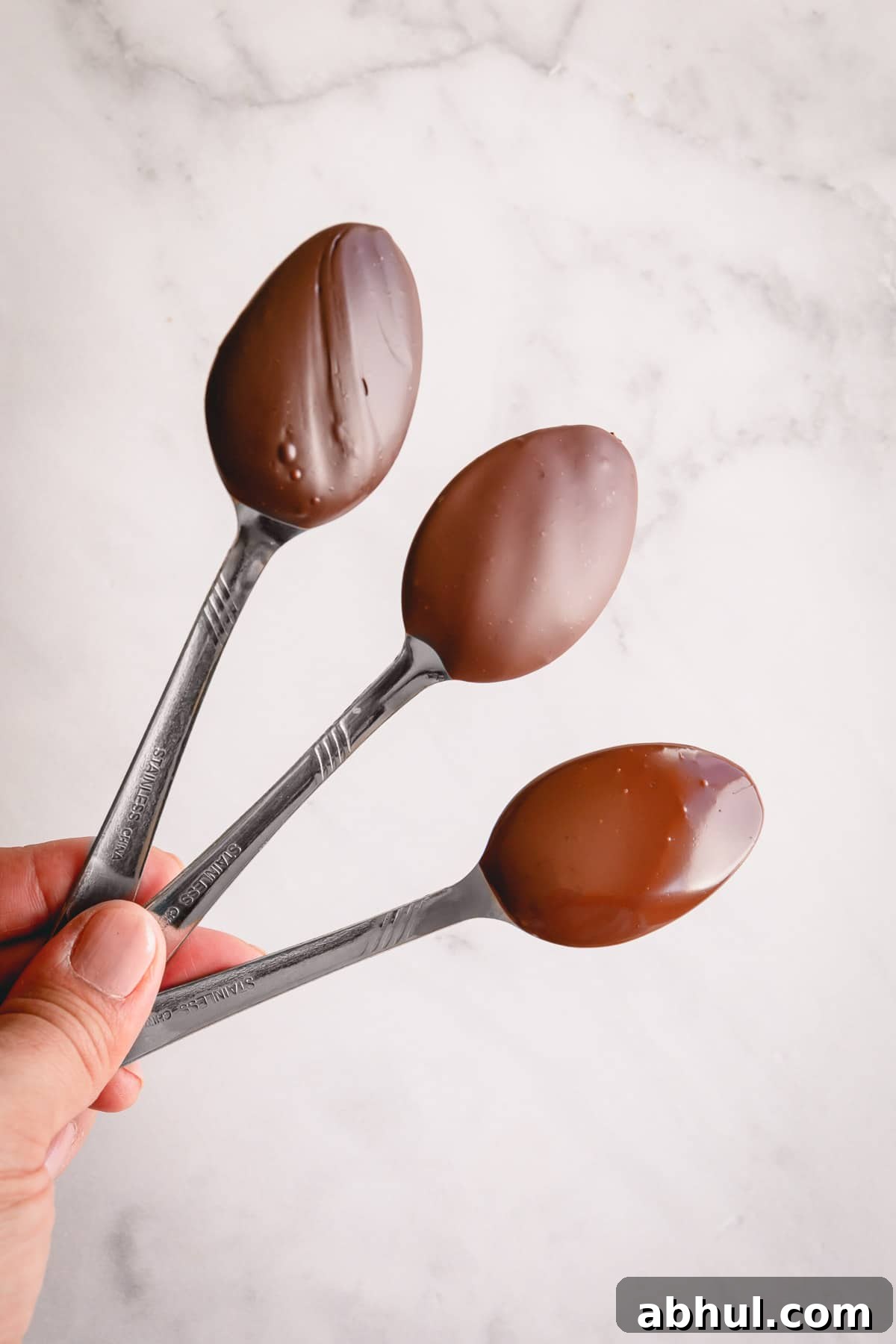
- Dip a spoon, piece of parchment, or a small scrap of chocolate into the melted chocolate.
- Let it sit at room temperature while you continue stirring the main batch.
- If it sets within 3–5 minutes with a shiny surface and breaks with a crisp snap, the chocolate is properly tempered.
- If it fails to set within 5 minutes or looks dull or streaky, the chocolate may have been overheated or has unstable crystals. Add a little more unmelted chopped chocolate as seed and stir to cool, then test again.
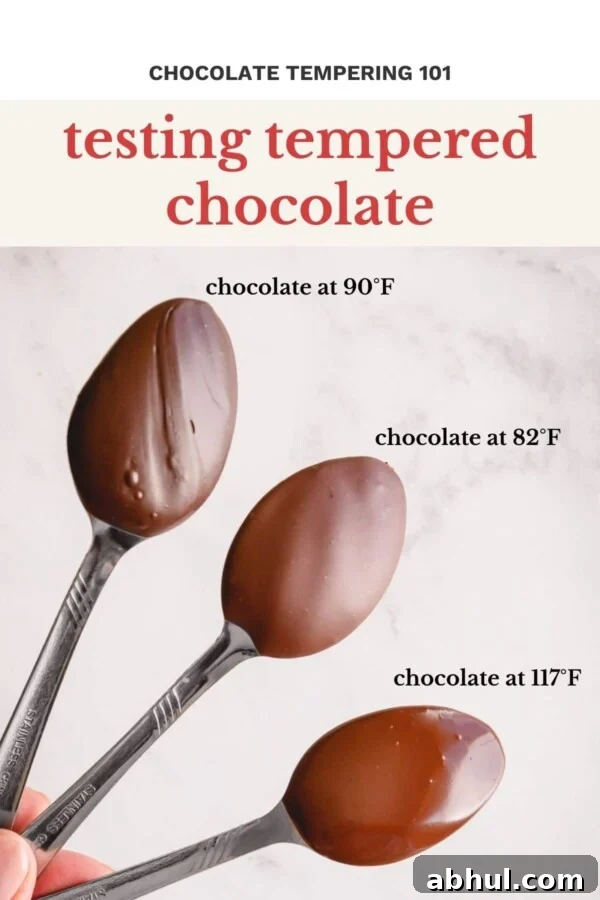
Example finishes from three temperature conditions:
- Perfectly tempered chocolate — set with a clear sheen and snap.
- Almost tempered — set but slightly dull.
- Simply melted without temper — very glossy while warm but slow to set and lacking snap once cooled.
How long can you keep tempered chocolate?
Tempered chocolate works best while still fluid during the shaping or coating process. If the working chocolate cools to around 80–86°F (26–30°C) you can briefly reheat it to about 90°F (32°C) to restore workability. Once chocolate fully cools and sets, it will need to be tempered again before reusing. The tempering process can be repeated many times.
How to store leftover tempered chocolate
- Pour leftover tempered chocolate onto a silicone mat or parchment and spread into a thin layer. Let it cool and set fully.
- Once set, break into pieces and store in an airtight container in a cool, dry place. Properly stored chocolate will remain stable, but avoid temperature swings and humidity to prevent bloom.
Tempering takes some practice, but once you understand the temperatures and how to encourage beta crystals, you’ll be able to produce shiny, snappy, professional-looking chocolate for coatings and decorations every time.